Borscht with rice
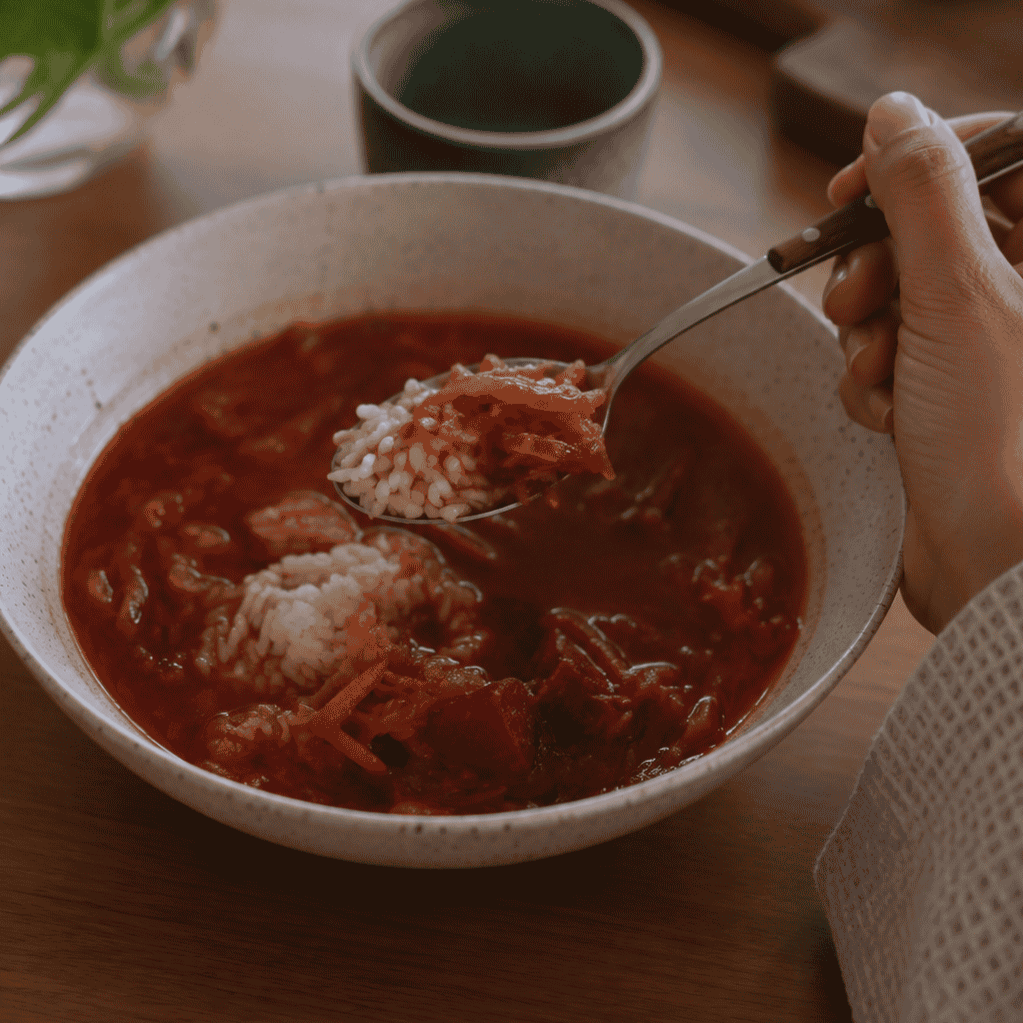
I grew up on borscht with rice. Not borscht with a side of rice – rice right there in the bowl with the borscht, together. Almost everything Russian came with rice at our house: fried fish, potatoes, whatever it was. We cooked with Russian ingredients but in a Korean way, our own way, and out of it came a third thing all its own. The best-known example is Korean carrot salad – morkovcha: it never existed in Korea at all. There was no proper cabbage on hand for kimchi, so our people improvised and made something like it out of carrots. You won't find the dish anywhere else in the world; it was Soviet Koreans who invented it. Same with borscht with rice: nothing like it exists in Korea today, and they wouldn't quite know what to make of it. All of it was born here, in the Soviet Union, among people carried thousands of kilometers from Korea who went on being Korean however they could. For a long time I thought it was just our family's food. Turns out it was a whole history – one I ate every day without knowing I was eating it.
So let me tell it. And my own story inside it.
How Koreans ended up in Russia in the first place
In 1860, under the Treaty of Peking, the Ussuri region passed to Russia, and the empire suddenly shared a border with Korea. Around five thousand Koreans were already living on that new land, and after that they kept coming, driven by famine, by having no land of their own, and – once Japan annexed Korea in 1910 – by flight from that too. By 1917 there were more than a hundred thousand Koreans in the Russian Far East. They planted rice, kept vegetable gardens, lived in villages of their own.
In 1937 it was all cut short. Stalin and Molotov signed a decree to remove the Korean population from the Far East, and within a few weeks 173,000 people were shipped to Kazakhstan and Central Asia – in cattle cars, into the bare steppe. Officially it was to keep Japanese spies from slipping in among the Koreans. In reality there were other reasons: fear, and cheap labor to open up undeveloped land. It was the first time in the USSR that an entire people was deported for its blood alone. Many were set down in an empty field before winter, and not everyone lived through that first winter.
There's another branch, entirely separate – Sakhalin. It wasn't Moscow that brought Koreans there, but Japan. From 1905 to 1945 the south of the island was Japanese, called Karafuto, and people from southern Korea were hauled there by the thousand as labor for its mines, logging camps, and construction sites. After the war they were promised a way home – the promise wasn't kept, and they were left stranded on the island for decades. Sakhalin Koreans are of southern origin, with a different road and a different memory, and they usually don't lump themselves in with the mainland ones. This matters: "Russian Koreans" aren't one people with one fate, but several separate streams that met on the same land.
Those whom 1937 had thrown into Central Asia came to be called Koryo-saram – "people of Koryo," after the old name of the Korean state. Out in the steppe and the irrigated fields they built their lives back up from nothing: rice, onions, melons, gardens. And when the ban on moving freely was finally lifted in the 1950s, many went looking for better land – to southern Russia and the Caucasus.
My family
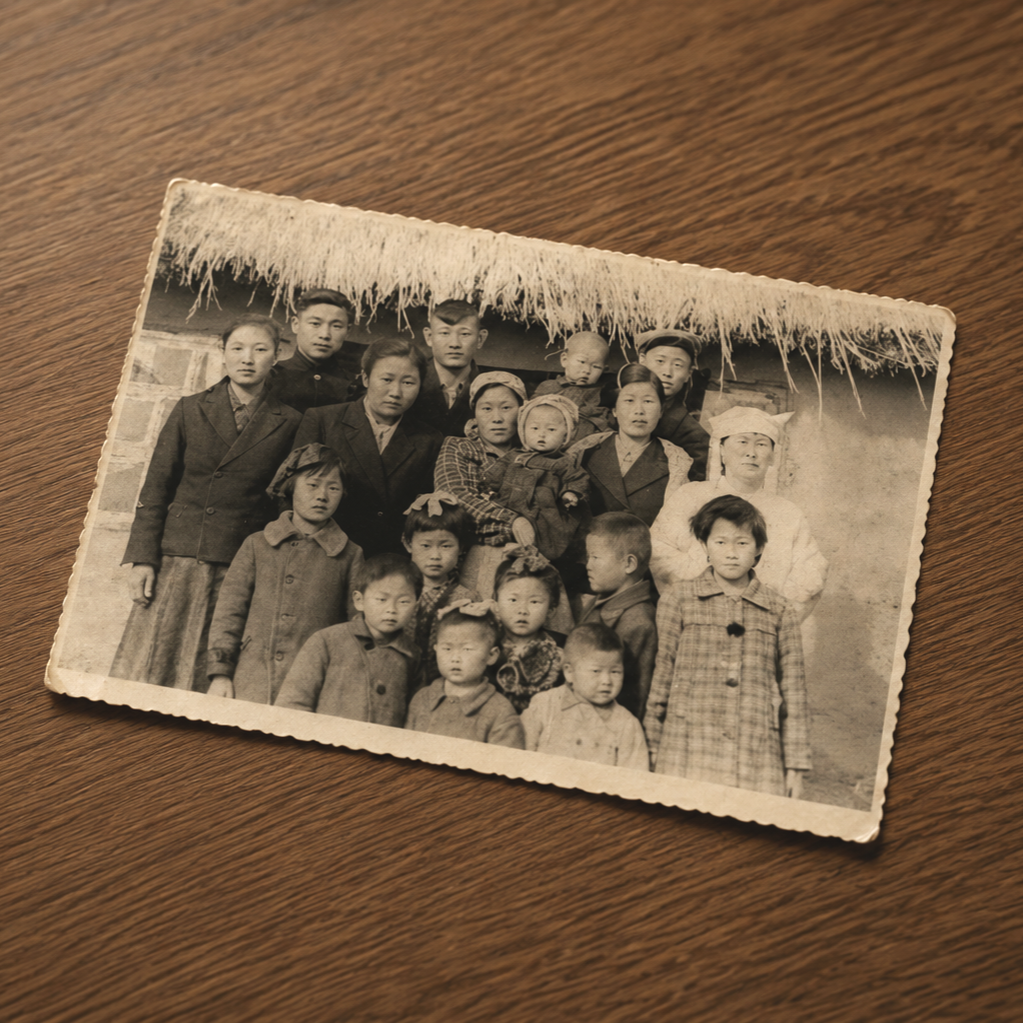
That's how mine ended up in the Caucasus. On paper it sounds dry: restrictions lifted, off they went for fertile land; the first Korean families in the North Caucasus turned up in Dagestan, near Kizlyar, and some later moved on from there. Behind that dryness are my grandmother and grandfather, and a small town called Maysky in Kabardino-Balkaria. My grandmother lived there; that's where I spent my whole childhood.
We lived off the land, generation after generation. Working the fields, growing whatever suited the local climate – that's how Korean families held on everywhere they were scattered, and mine were no exception. They took poor land and made it yield; that's what they lived by in the Soviet Union.
My grandmother spoke Korean. She knew Russian, but a good seventy percent of her was still Korean – the home kind. My mother understood her but already spoke less of it. We grandchildren knew only a little, and not at all the Korean you hear in Seoul today. The language even has a name – Koryo-mar. It grew out of the northern Hamgyong speech of the first settlers, and over a century and more it drifted so far from modern Korean that to a South Korean today it sounds like something old, something other. For a long time I called it "old Korean." Which is basically what it is.
Koreans lived as a diaspora – in the Caucasus, on Sakhalin, in Uzbekistan, everywhere, in communities where everyone knew everyone and everyone was related, even if only distantly. The feeling inside was simple: we're a little different. Set apart. Not like the people around us. No arrogance in it – just a fact. We kept both the Russian holidays and our own. We buried our dead somewhere between the two ways. The customs were half Korean, half already something else. Like that bowl of borscht with rice, all of it lived between two cultures, and inside the community no one gave it a second thought. It was simply life.
What of it is in me
On me, though, it was a different matter.
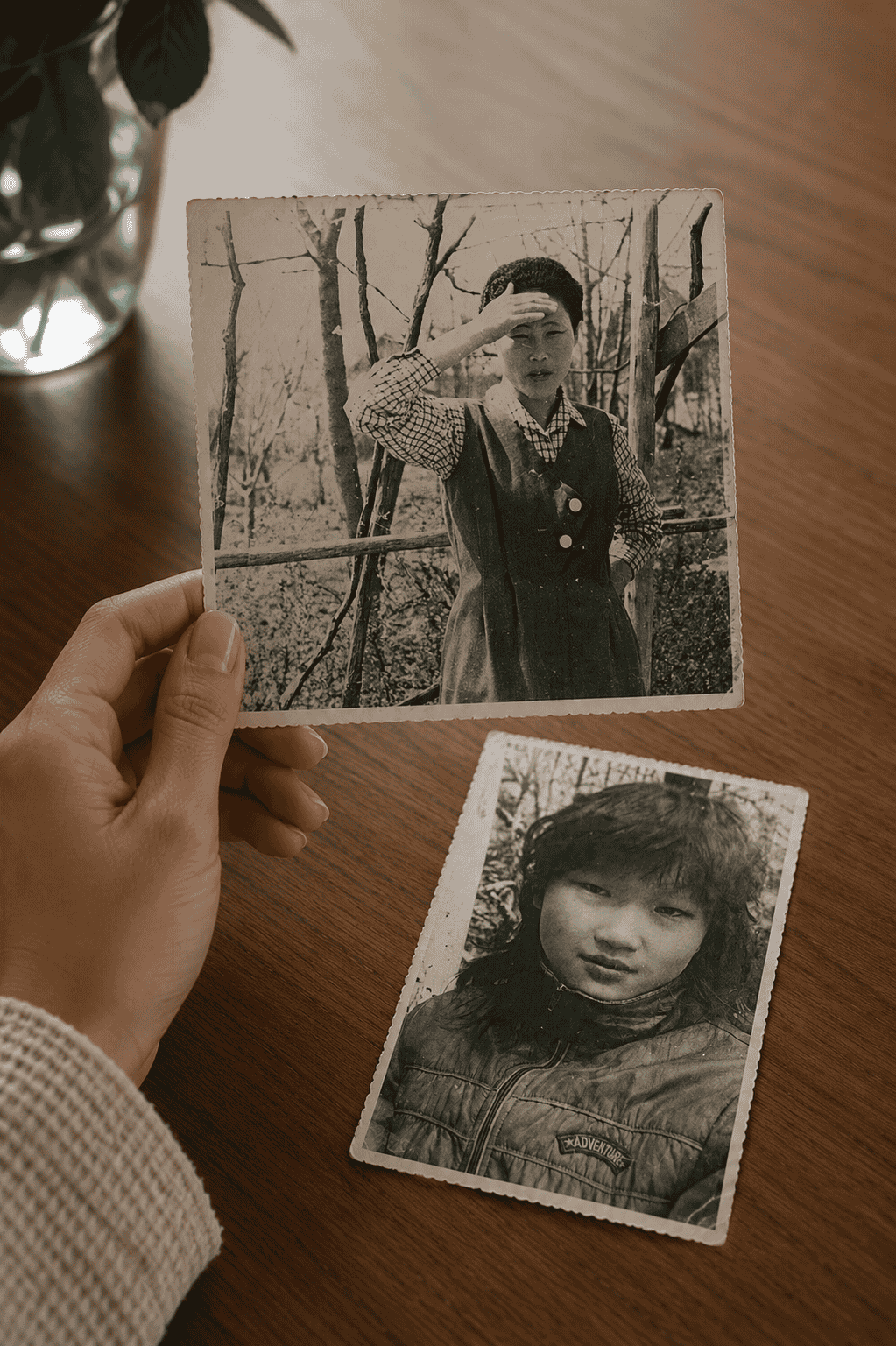
By temperament I'm more Russian: I think, speak, and feel in Russian. But my face is Korean, and that's where it all began. Children don't pretend – from the way they react you can tell at once whether they've accepted you or not. More often than not, they didn't: in the Caucasus especially, and in Moscow too, where we landed after years of moving around. I could barely connect with the other kids; they teased me, and as a child that's hard to carry. Bit by bit you build up some armor and learn to stand up for yourself; that's probably how a person gets put together. But it leaves a mark: I still find it hard to meet people, and the loneliness reaches all the way back to those years.
In return, your instincts sharpen early. You start reading people before you understand yourself: who's in what mood, what the air in a room is like, where things are good and where they aren't. Sometimes you read too much into things – all of that experience mixes into how you see. But you also pick up on subtler things, and that has stayed with me.
I'd lived my whole life in Russia up until then – kindergarten, school, university, work. I moved to Korea only as an adult, around twenty-five, and there everything flipped. By looks I was finally one of them; I really am Korean, after all. But the moment I opened my mouth I gave myself away: however cleanly I spoke, what they heard in me wasn't a Korean but a Russian cast of mind. They even have a word for people like me there – Koryo-saram. It was a mirror image: in Russia the foreign thing about me was my face, in Korea it was the inside. In both places I wasn't one of them, and truly – nowhere.
For years I couldn't make peace with it; the hurt didn't let go. Then things shifted: I lived in a few different countries, saw how life can be, and began meeting other kinds of people – ones who find your difference interesting rather than a problem. A place turned up where that difference has room to breathe. That turned out to matter.
Character and work
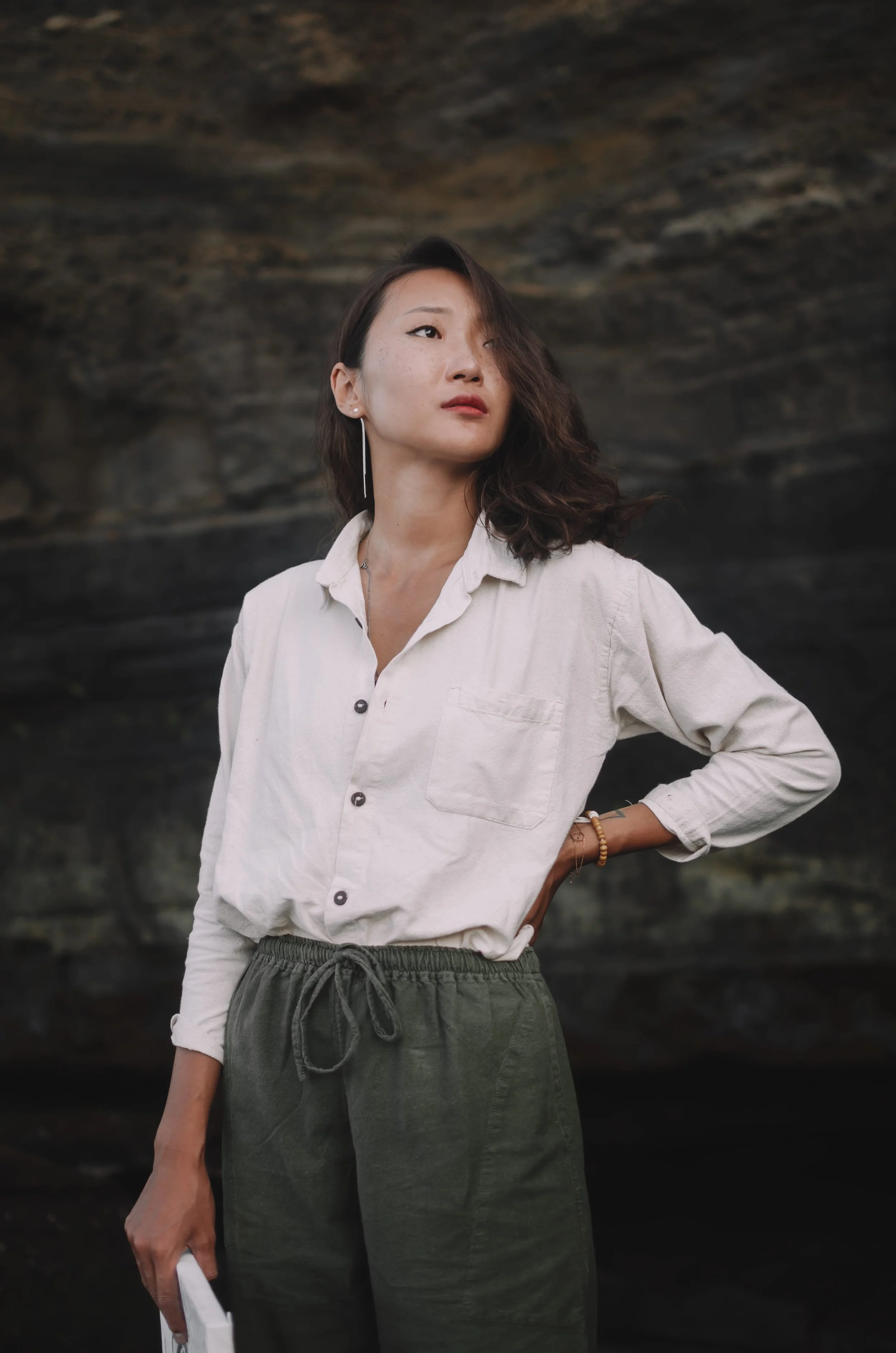
I have a rough sense of what in me comes from where. Discipline and restraint, the habit of keeping slightly apart, a fine attentiveness and the ability to stay present – that's more the Korean side. The Russian side gave something else: throwing myself into the work completely, with depth and passion. Inside me, the one doesn't crowd out the other.
This is where life and work meet in a single point. In painting I've always been drawn to the same thing – strength beside fragility, impulse beside discipline. Not contradictions to be resolved, but opposites: they live together and don't cancel each other out. Exactly what goes on inside me. I didn't choose this subject as an artist – I grew up inside it.
And now it comes out directly in the work. My new series, in pencil, is called just that – The In-Between: the place between two things, a moment before it becomes one or the other. Not a choice, but something kept open. That same "between" where I once couldn't find a place for myself is now what I draw on purpose.
I wouldn't wish it on the child I was. And at the same time I'm glad it turned out the way it did. Both at once – it's always like that with me. These days it's no longer about discomfort, or about nursing a hurt. It's about what I'm made of.
The borscht with rice, by the way – I still eat it.
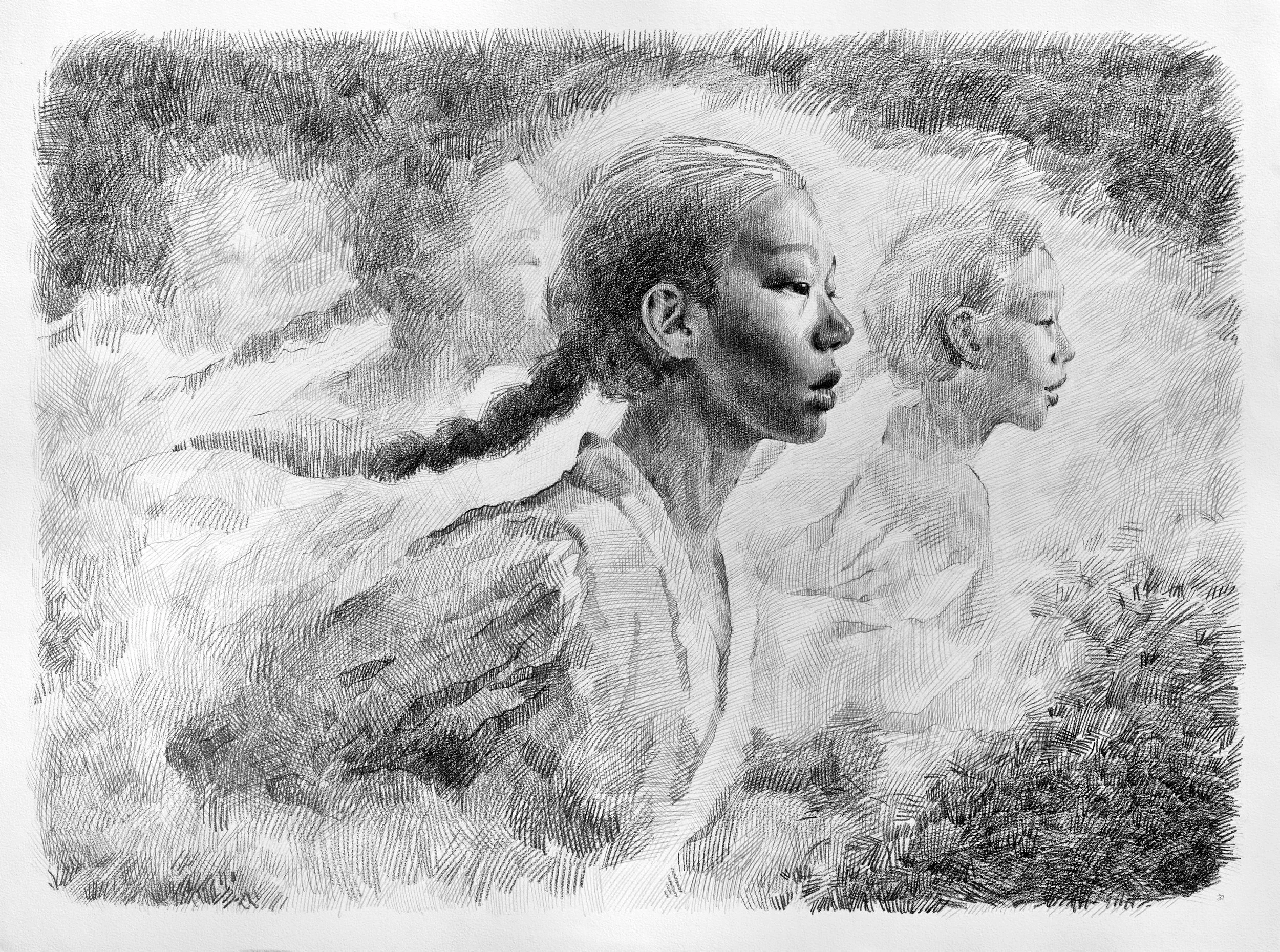
Striving or Fleeing. Running towards something. Forward, to the next, to the better, to what's about to happen. But what if all this time it wasn't towards, but away? From the outside it's one movement. The difference is only inside – and you don't always know it yourself.
From the series The In-Between
Pencil on Paper, 2026
76 × 56 × 0.1 cm
Original drawing, signed. One of a kind
