Mugunghwa: Painting Analysis
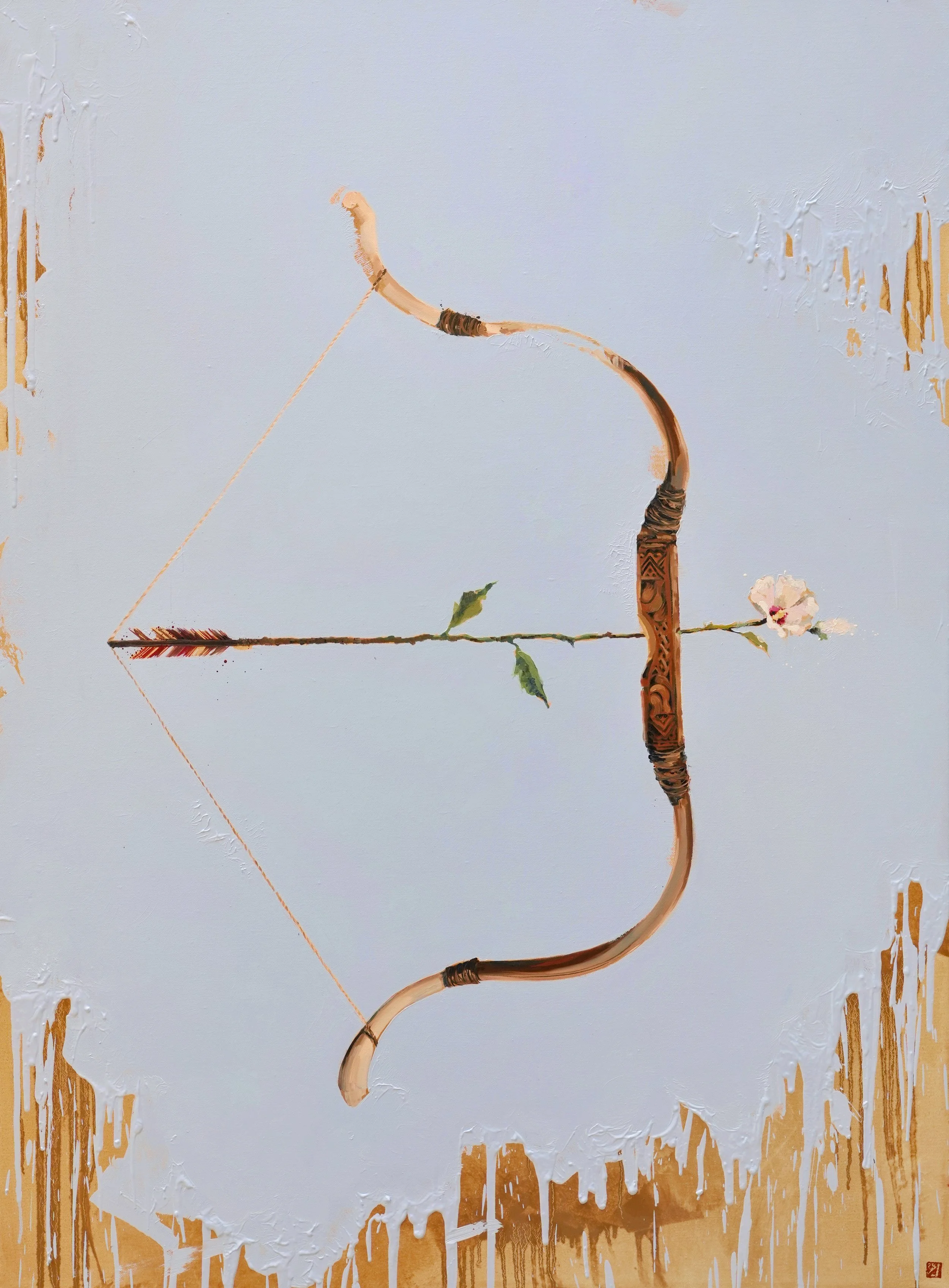
This features two objects from two countries.
A Russian bow. Wood, binding, a carved handle. The bowstring is drawn. The arrow is in place. Red combat fletching. But there is no arrowhead. In its place is mugunghwa, the national flower of Korea.
This is not just an aesthetic still life or a play on contrasts. It is a self-portrait. A documentation of a complex identity and two entirely different ways of surviving.
The Drawn Bowstring
I was born and raised in Russia, in the small town of Mayskiy in the Caucasus. This environment dictates its own rules and forms a rigid internal framework. The Russian bow on the canvas is a metaphor for a character forged by the land and circumstances.
It is about the necessity to be strong. About systemic thinking, structure, and the highest standards. My internal bowstring is always drawn to the limit: total control, readiness to take responsibility for the result, perfectionism, and an intolerance for my own weaknesses. It is a weapon of direct, piercing action. It requires colossal mobilization, it hits the target flawlessly, but it inevitably burns through resources.
An arrow flies only once. And this shot takes everything you have.
The Flower Without End
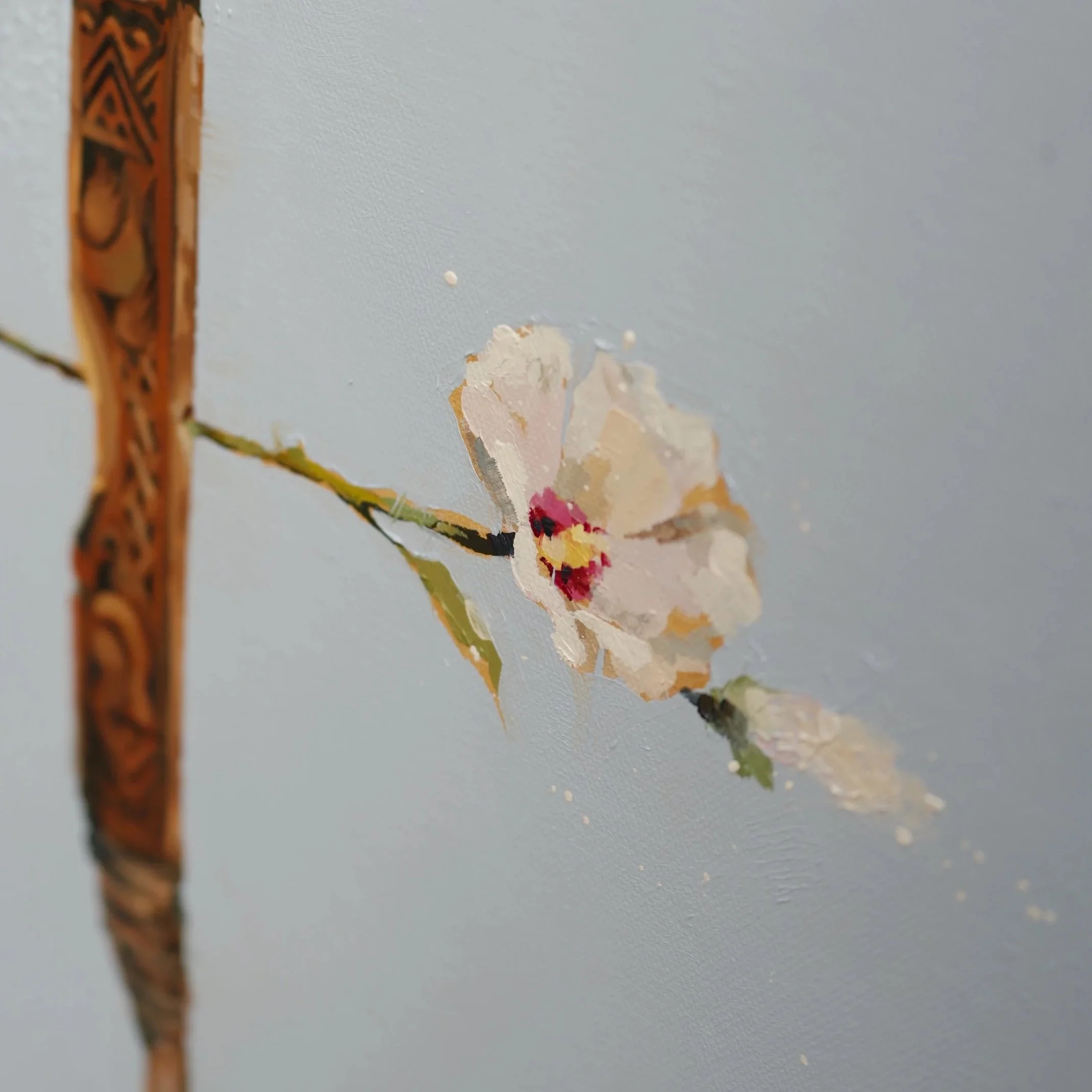
At the tip of the arrow, there is no deadly metal. There is mugunghwa.
I am Korean, and this flower is my blood, my DNA. Mugunghwa blooms in the morning and fades by evening. The next morning, the bush opens new buds – and so it goes from July until the cold. The name itself means "the flower without end."
This is a power of a completely different order. It is not about an aggressive breakthrough, but about a quiet, genetic indestructibility and cyclicality. It is deep empathy, the capacity for reflection, and the ability to recover after complete burnout. When the piercing power of the bow is exhausted, the nature of the flower kicks in. The ability to find new meanings and be reborn every day, even when it feels like there is no strength left.
The Convergence Point
Within me, these two paradigms constantly collide. The ruthlessness of the inner critic and the constant drive meet the need for humanity, contemplation, and vulnerability. For a long time, this felt like a conflict. It seemed necessary to choose just one: either impenetrable armor or openness.
But on the canvas, they become one. One directs, the other gives meaning. An arrow flies only once. The flower returns every morning, four months in a row. This is not weapon that has lost its point. These are two weapons with different lifespans. The power of the first is to strike the target flawlessly. The power of the second is to keep blooming even when all the arrows have been shot.
