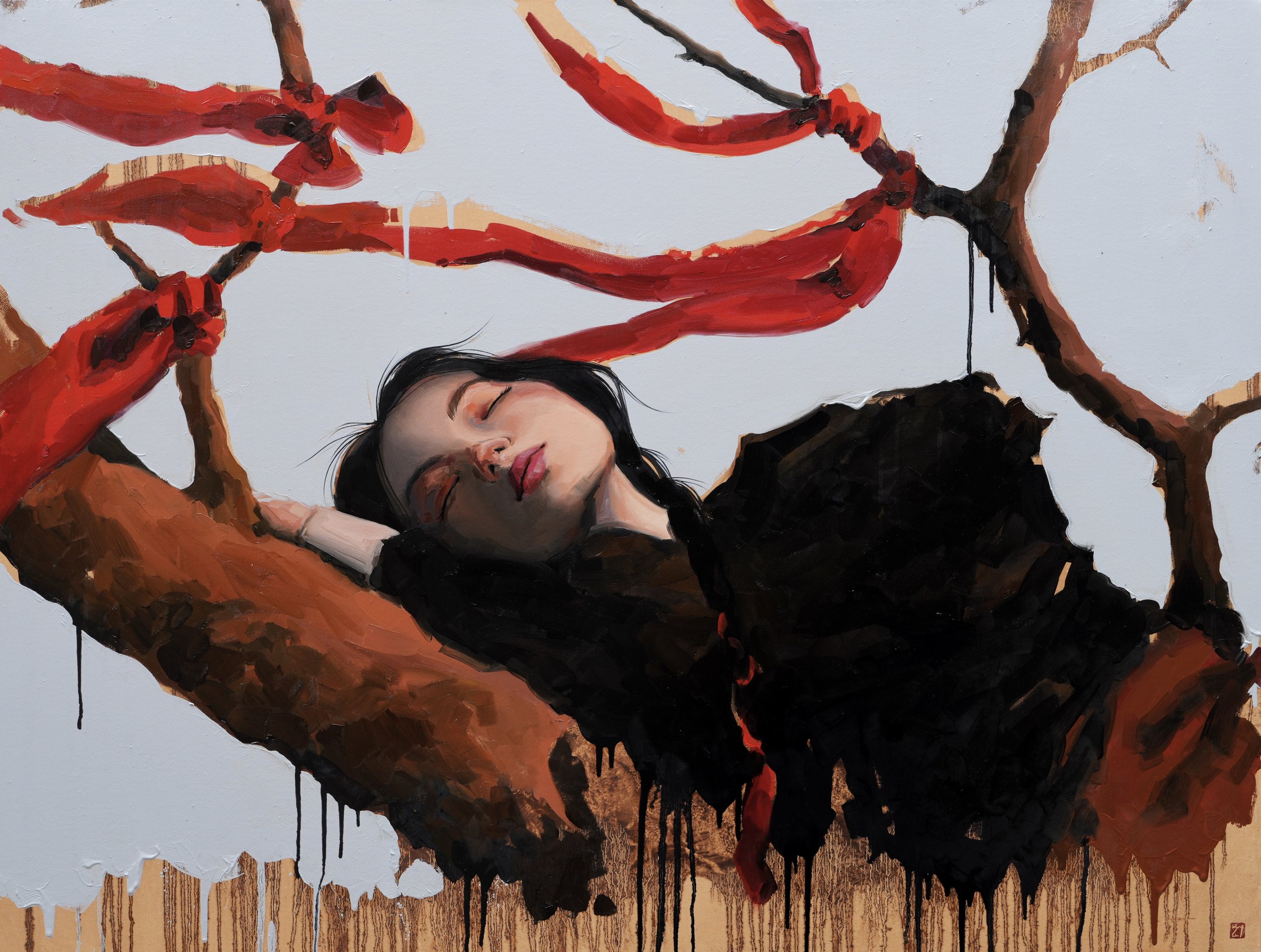
Sometimes I want to draw a red line on my studio floor and say that no one is allowed past it. Leave everything outside. Other people's expectations, worries, the need to make decisions. Switch off my phone. Set aside responsibility, even if only for a couple of hours.
In Korea, a line like that is drawn around an old tree. It's called shinmok – a sacred tree.
Two sides
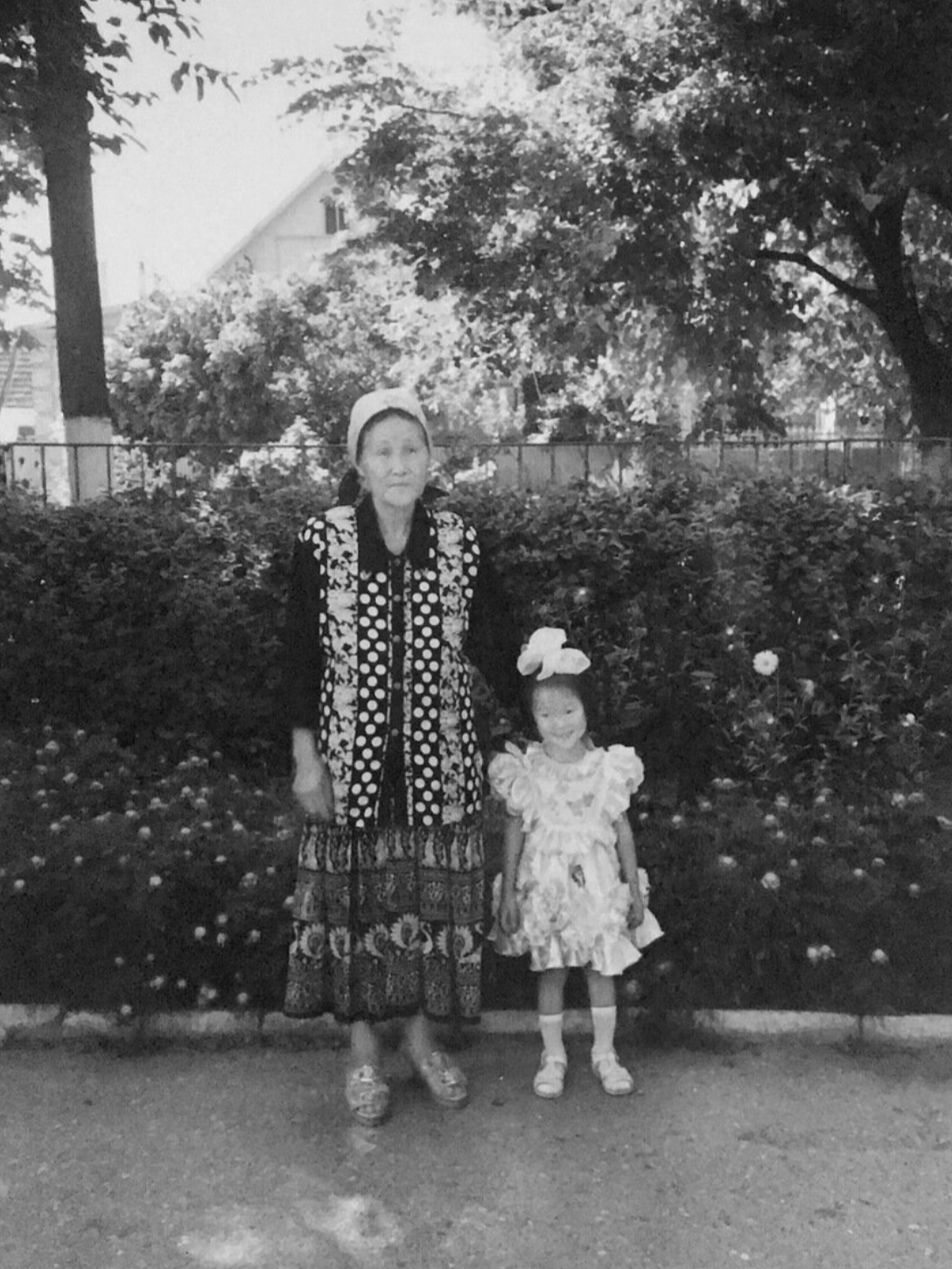
I grew up in Maysky, a small town in Kabardino-Balkaria in the North Caucasus of Russia. My family is Koryo-saram – ethnic Koreans of the former Soviet Union. In 1937, Koreans were deported from the Russian Far East to Central Asia. At a stroke, it broke people's lives and took them from their homes. We lived in a strange hybrid. Outside was an ordinary Soviet, Caucasian way of life. At home, it was closely mixed with Korean ways.
My grandmother thought and spoke in Korean. Sometimes she switched to Russian – she knew it. No particular phrase of hers has stayed with me, but she was really good at swearing. I've already written about our food in 'Borscht with rice'.
Later I moved to Korea. That's where the duality hit me with full force. In Russia, I had always been the Asian one. People looked at my face and drew their own conclusions. In Korea, I fitted in right up until I opened my mouth.
You're always caught in between. Trying to balance the expectations of two completely different worlds. Trying to be the right kind of person for both sides. It means constant, total control over yourself. At some point you get tired of the tension. Of always having to hold it together. You start to physically need a place where you can breathe out. A closed-off shelter where none of the rules apply.
A boundary at the edge of the village
I've never seen a shinmok in person. I knew about these trees, but only vaguely. When I started gathering material on Korean symbolism, shinmok came up again. I was hooked by how it works, and I started looking for ethnographic texts.
In Korea, a sacred guardian tree often stood at the entrance to a village. Most often a huge zelkova, sometimes a ginkgo, a hackberry or an old pine. These trees can be three hundred, even five hundred years old. The tree worked as a boundary. It divided the world into outside and inside.
The trunk was bound with a straw rope called geumjul. No one stepped over it, no one broke the branches. Stones were piled up at the roots – the same kind of stones I wrote about in 'Cairn'.
But people also came to the tree alone. A person would come and tie a strip of cloth or paper to its branches, usually white or five-coloured. In the painting, I kept only red: in Korean tradition, red has long been believed to keep misfortune away.
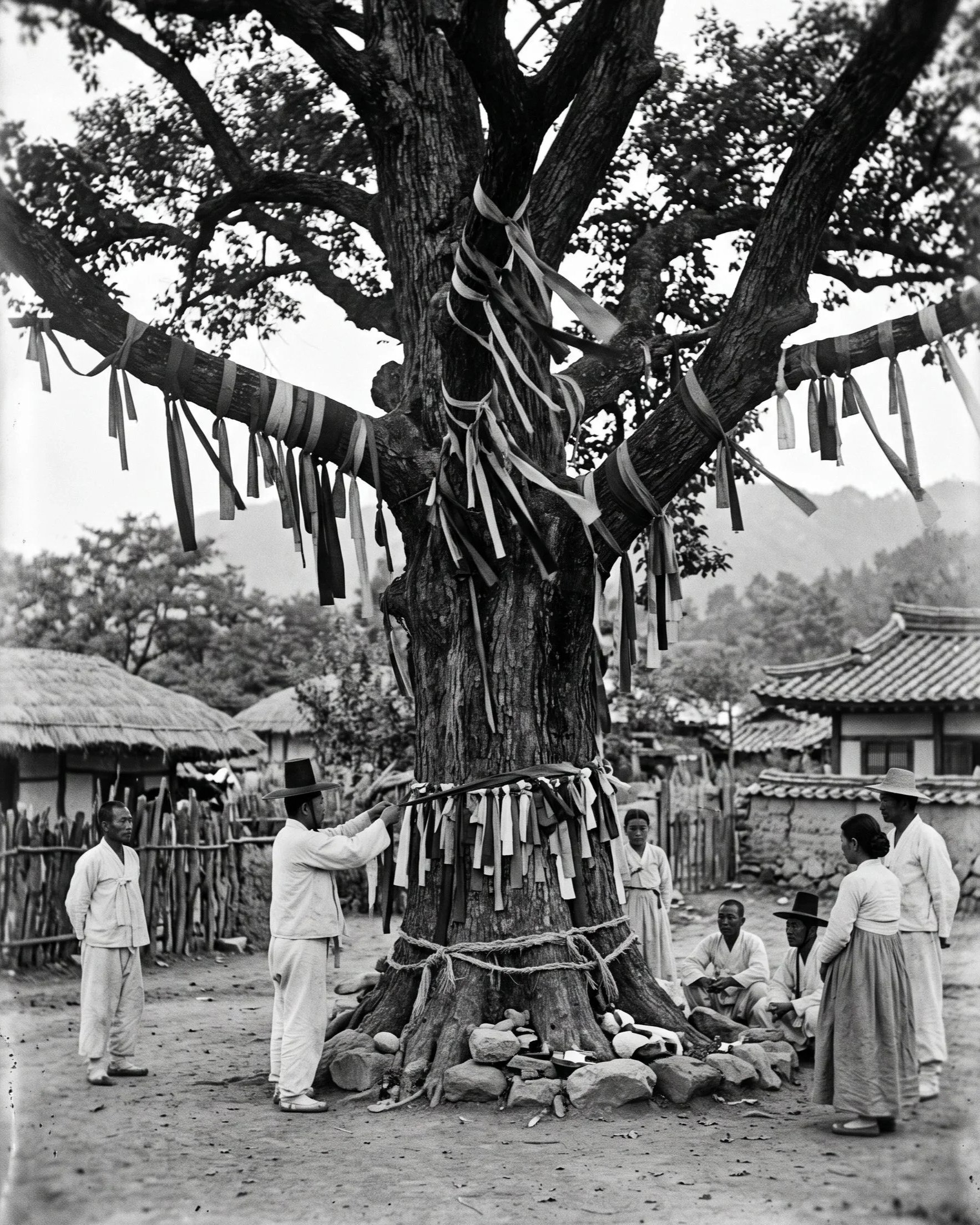
I imagine that along with the ribbon, people left their burden on the branches too. They shed the weight they had been carrying, and the tree took it.
Beyond that line, no one could touch you. That was exactly what I was missing. An accepted way to put down my hyper-responsibility. The right to a long pause. You're not okay, so you come to the roots and admit you can't cope. And the old custom seems to give you that right.
Air on the canvas
That's how Shinmok found its place in the Given series. That's where it will stay. But it was this painting that pushed me towards a separate series about the plant world – Root. Flowers, trees, everything that grows. That's where this story about nature will unfold in full.
Technically, the painting was straightforward: oil on linen is what I always use. The hard part was something else.
I needed to catch the wind.
I was looking for exactly the right lightness. Getting the red ribbons to flutter in the air turned out to be the hardest part. The canvas needed something fleeting. Serenity.
Red ribbons in the wind are that one second when the tension drops. Nothing more is asked of you. You don't have to be strong any more. Just breathing is enough.
Without this context, it's just an ordinary painting. A girl asleep on a tree branch.
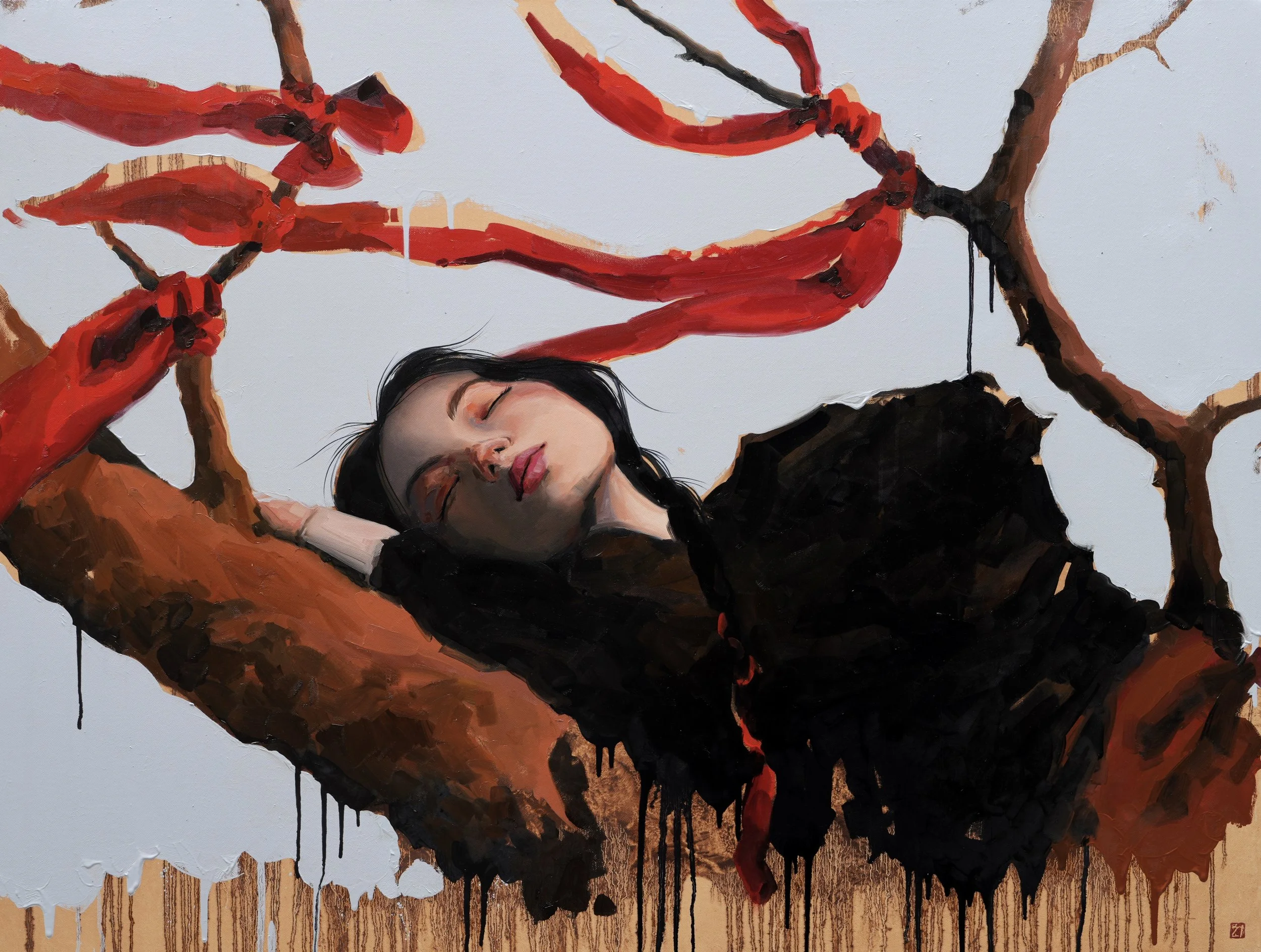
In Korean tradition, Shinmok is a guardian tree. Historically, people tied red ribbons to its branches to leave their burdens behind and release their accumulated inner weight. This act created a strict boundary: the red lines marked a perimeter within which a zone of absolute sanctuary and stillness began.
In the context of this artwork, this space becomes a metaphor for an inner refuge. The piece captures a state where a person allows themselves to let go of total control and no longer bear responsibility for everything around them. It is a reflection on the right to vulnerability and a restorative pause – that point where one no longer needs to be strong, and it is enough to simply be.
From the series Given
Oil on linen canvas, 2026
90 × 120 × 5 cm
Original painting, signed. One of a kind.
All prices are in USD.
